
Roofing and Drone Roof Surveys
We strip, re-cover, repair and maintain pitched and flat roofs on period and interwar homes across South-East London and Kent: full re-roofs, slipped and broken tiles, flat roof replacement, leadwork, chimneys and guttering. Every quotation starts with an inspection, on foot where the roof can be reached safely and flown by drone where it cannot, so the price answers the actual fault rather than a guess.
- Typical programme
- 1 day to 3 weeks on site
- Quotation
- Fixed and written, after survey
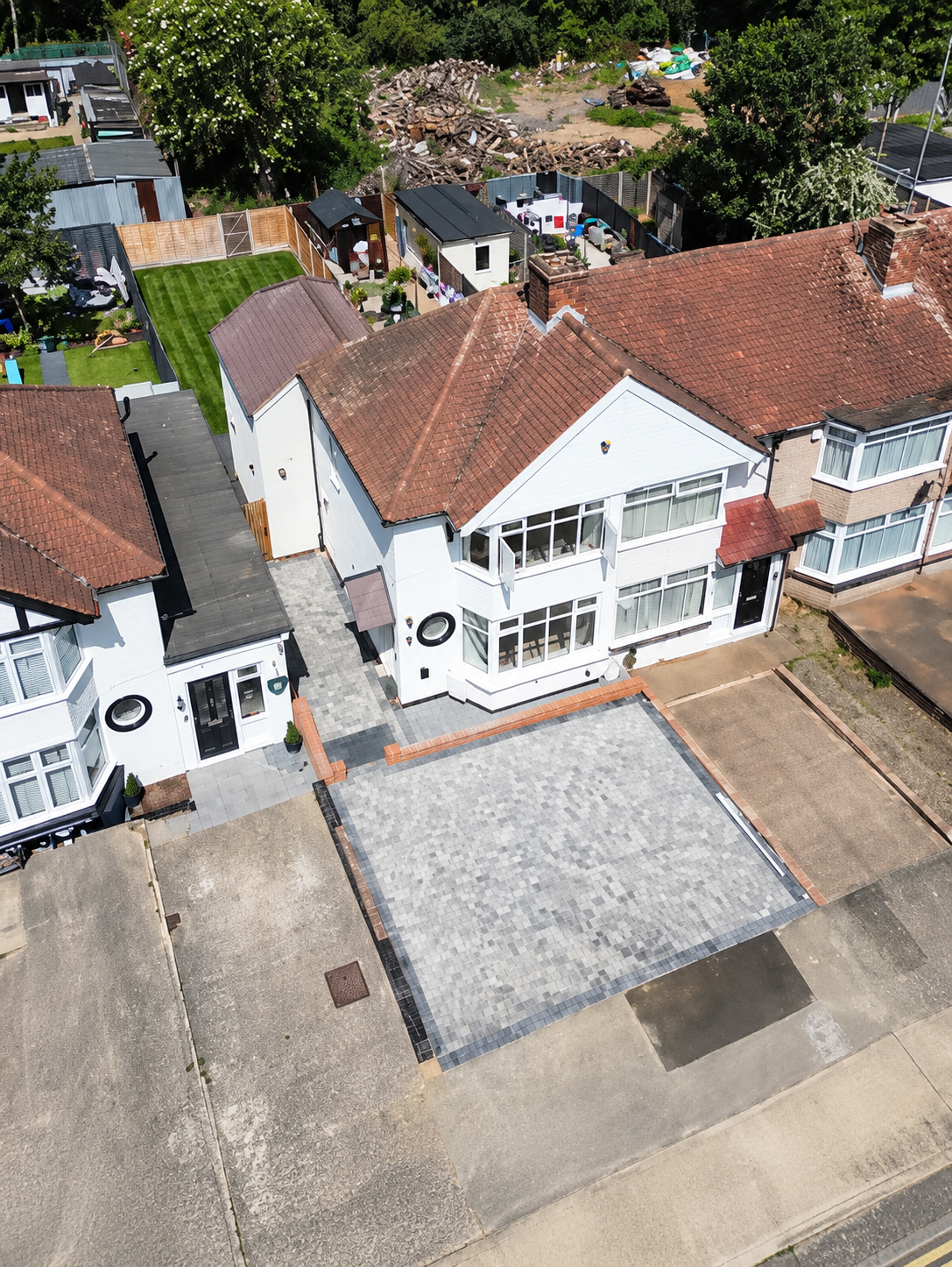
The roofs we work on
Most of the housing stock here is pitched and covered in natural slate, clay plain tile or interlocking concrete, sitting on rafters that were never designed for the weight of a modern re-cover. Behind the front elevation there is usually a good deal more: a lower back addition roof, a shared valley with next door, a parapet gutter, and a flat roof over a bay or an old outrigger. We work on all of it, on the whole roof or on a single defect, and we price the two differently.
New roofs and full re-covers
A roof that has had its third patch repair in two years is telling you something. A full strip and re-cover takes the covering back to the rafters, so the timber, the wall plates and the valley boards are finally visible and anything rotten comes out before the new roof goes on. We re-cover in natural slate, clay or concrete tile, on a breathable membrane and treated battens, with new lead to the valleys and abutments and the ridge and hips bedded or dry-fixed.
Where the existing rafters will not carry the covering you want, we say so at the survey rather than halfway through the strip. Swapping a slate roof for concrete tile is a substantial increase in dead load and is not a decision to take on site.
Roof repairs
Most leaks are not the covering. They are a slipped tile, a cracked valley, a mortar fillet where somebody used sand and cement instead of lead, a blocked outlet backing water up under the slates, or a chimney flashing that was never dressed properly. We find the fault first, repair the part that has failed, and tell you honestly how much life the rest of the roof has left.
Emergency work is temporary by design: sheeted and made safe on the day, then repaired properly once the weather and the access allow it.
Flat roofs
Flat roofs over extensions, dormers, outriggers and bay tops fail for two reasons, standing water and movement at the upstands. We strip back to the deck, correct the fall with new firrings, insulate to current Building Regulations and re-cover in single-ply membrane, GRP or high-performance torch-on felt depending on the detail and the traffic the roof has to take. Upstands, drip edges and outlets are the parts that decide how long it lasts, so they are specified in writing.
The work around the roof
Chimney stacks repointed, re-flaunched or rebuilt, with pots and cowls fitted and redundant stacks capped and vented. Leadwork to valleys, soakers, box gutters and abutments, in the right code and with the right joints, because a lead detail that cannot move will split. Gutters, downpipes, fascias and soffits renewed and re-hung to a proper fall, since a large share of the damp walls we are called to look at are caused by a gutter rather than the roof above it.
Inspecting the roof first
No roof is priced from the pavement. Where the roof can be reached safely we inspect it on foot or from a ladder, lift a small area where the evidence points inside, and check the loft from below for daylight, staining and movement. That visual inspection is part of every roofing quotation and is not charged separately.
Drone roof surveys
Where a roof cannot be reached safely or cheaply, a rear slope bounded by a neighbour, a tall or complicated stack, a parapet gutter three storeys up, we fly a camera drone instead and photograph every slope, valley, abutment and chimney at high resolution. No scaffold, no cherry picker, nobody working at height, and we can be over the ridge within minutes of arriving.
You get a written report with annotated images, the defects located on a plan view of the roof, and a plain recommendation: monitor it, repair it, or replace it. The full image set is yours to keep, which is useful for an insurance claim, a party wall discussion or a pre-purchase decision. If the report leads to work, it becomes the specification we price from.
A drone survey can also be booked on its own, with no roofing work attached to it.
What people ask about this work
Does the whole roof need replacing, or can it be repaired?
Very often it can be repaired, and we will tell you when that is the honest answer. A slipped tile, a split valley or a failed flashing is a repair. A covering that is delaminating across every slope, or a roof on its third patch in two years, is a re-cover, and money spent patching at that point is money you lose. The inspection is what tells the two apart.
How long does a new roof take?
A full strip and re-cover on a typical terrace is usually five to ten working days once access is up, and a back addition or a small flat roof is often two or three. The weather decides more of that than we do, which is why we sheet the roof at the end of every day and never strip more than we can make watertight before we leave.
Do you take on flat roofs as well as pitched ones?
Yes. Extensions, dormers, outriggers and bay tops, re-covered in single-ply membrane, GRP or high-performance torch-on felt. We strip back to the deck and correct the fall with new firrings rather than laying a fresh covering over a roof that has always held water, because standing water is what ends most flat roofs early.
Do I need scaffolding for a drone roof survey?
No. That is the point of it. The whole inspection is flown from the ground, so there is no scaffold to hire, no cherry picker to book and nobody on a ladder. If the survey then shows work is needed, access is priced as part of that work rather than spent finding out whether it was needed at all.
Can you survey a roof I share with a neighbour?
Yes, and it is one of the most common reasons people call us. On a terrace or a semi the rear slope, the shared valley and the party stack are often impossible to see from either property. A flown survey covers them in one visit, and the images are frequently what settles a conversation between neighbours about who pays for what.
Tell us what you are trying to do with the house.
We will come out, measure up and tell you honestly whether it works. The site visit and the written quotation are free, and there is no obligation attached to either.